The hardest part of the first year is realizing how quickly the small things — the smell on the bed, the sound of the nails on the floor — start to leave.
The first month after, the small specific things are still loud. The smell on the bed. The dent in the cushion. The sound of nails on the wood floor that you hear at three in the morning even though you know.
By month two, the smell on the bed has started to fade. You bury your face in it and it's not quite him anymore. By month three, the dent in the cushion has gone out, because no one has been sitting in it, and you can't remember exactly the sound the nails made. You know it was a certain rhythm. You can almost hear it. But not quite.
This is when most people start looking for something to hold onto.
What follows is a list of twelve things people do. None of them bring him back. All of them, in different ways, give the love somewhere to go. You don't have to do any of these. You certainly don't have to do all of them. One is enough. Read through, see what your hand reaches for, and let the rest go.
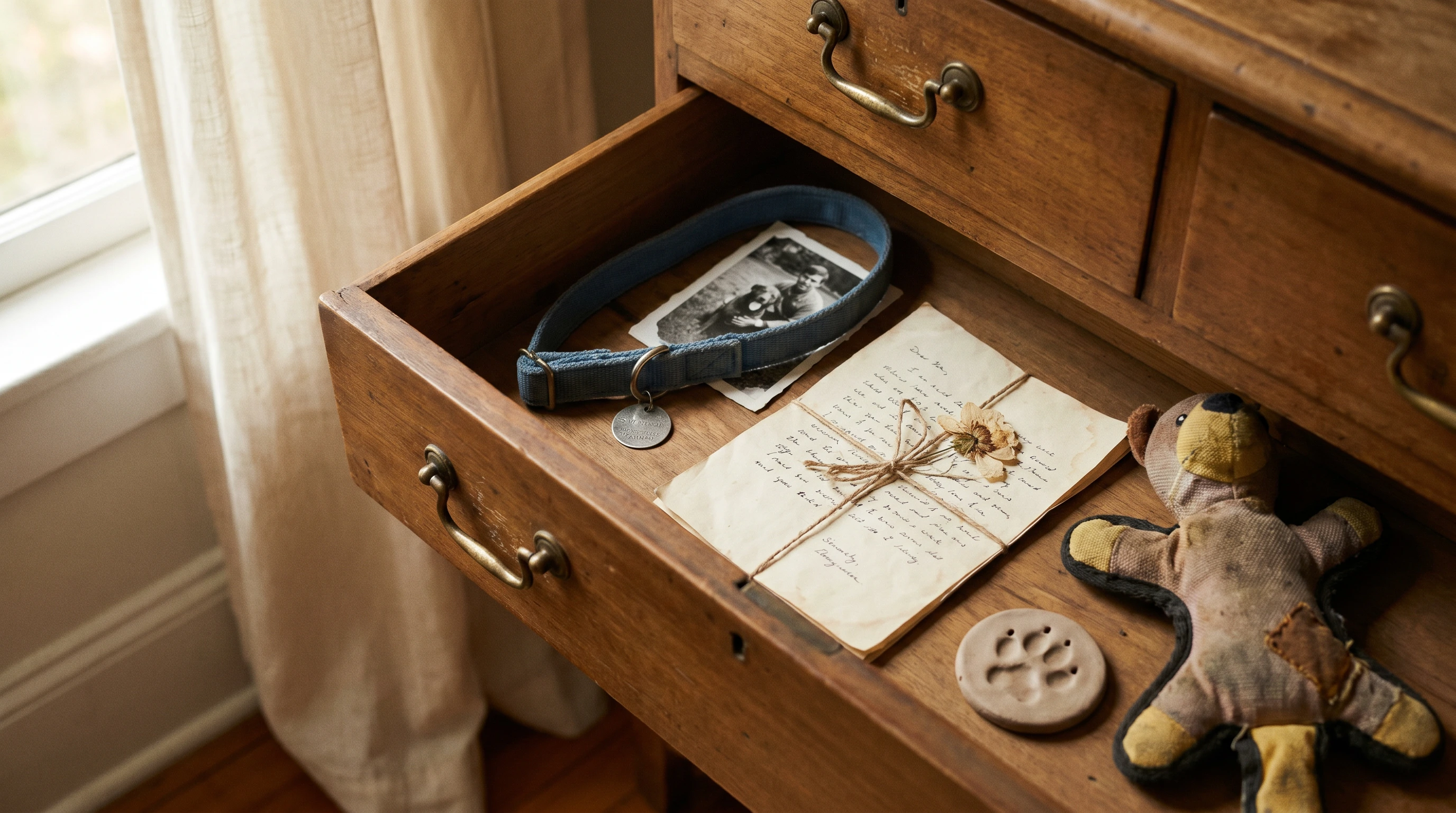
Keep one physical object
One. Not the whole drawer of his things. One.
It might be the collar, with the tag still on it. It might be the leash. It might be the blanket from his bed, the one that still smells like him for a few weeks if you don't wash it. The bowl. The favorite toy, the one he carried around for nine years until the squeaker broke.
The reason to choose one is that everything becomes important if you keep everything, and then nothing is. Pick the object that, when you hold it, makes you cry the right way. The way that feels like remembering, not like drowning. Put it somewhere you can find it. A box on the top shelf of the closet. A drawer in the nightstand. Not displayed. Just kept.
The rest can be donated to a shelter. He would have wanted his good blankets to go to a dog who needs them.
The framed photograph
The right photograph, in a real frame, on a wall where you see it every day.
Most people have the photo on their phone. The phone gets full. The phone gets replaced. The photo stops being something you see and becomes something you have to search for. A printed photograph in a frame is the opposite. It is in the room. It is at eye level. It is part of the house.
Choose the one where he is looking at you. Get it printed at a real print shop, not a drugstore. Get a frame that costs more than the print. Hang it where you walk past it on the way to making coffee.
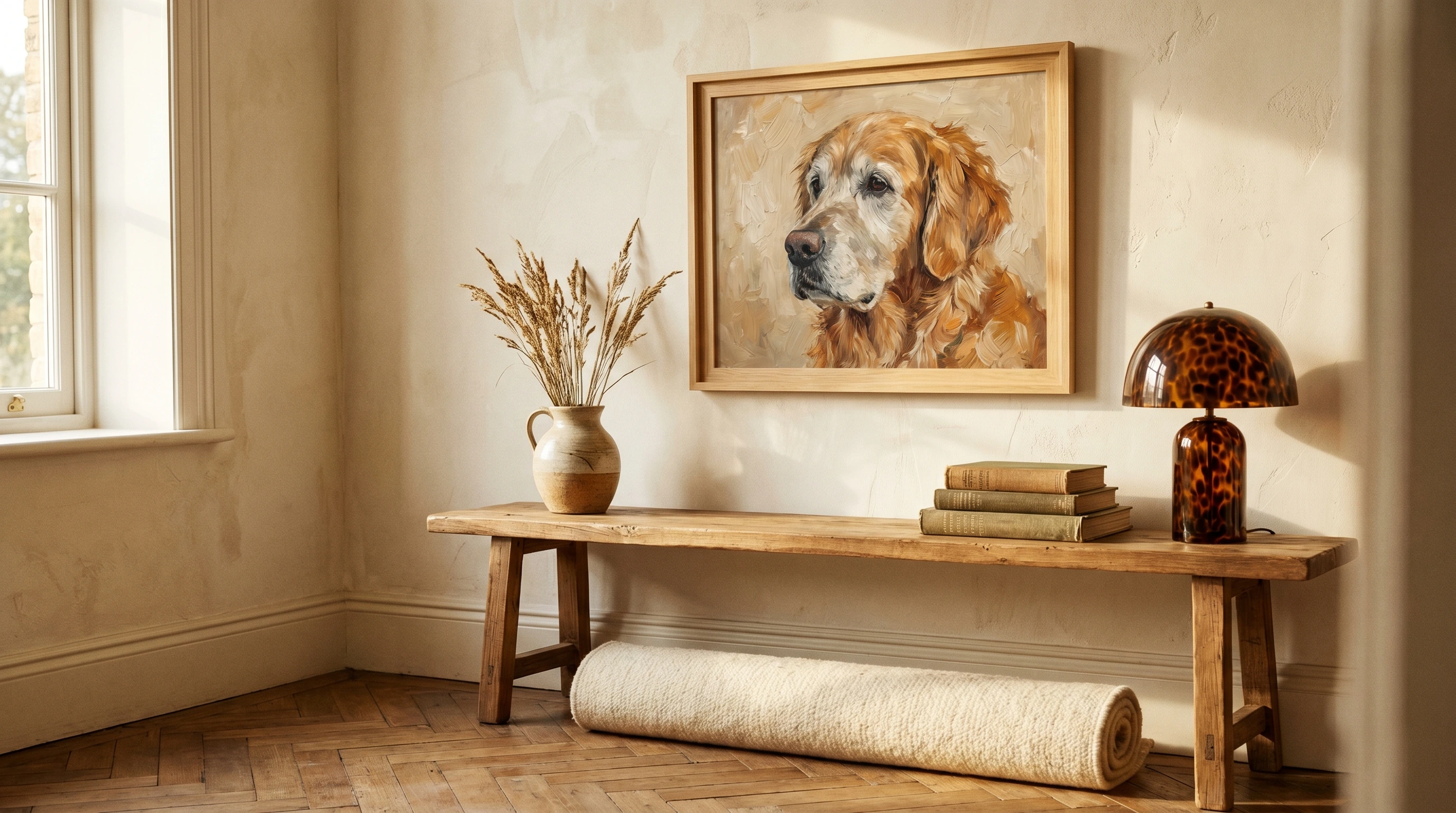
A commissioned painting
This is one of the things some families do. A painter — a person, in a studio — works from a photograph of him over a few weeks. The result is hand-finished, oil-and-pigment on canvas. It hangs on a wall and it does not look like a printed photo. It looks like a portrait, the way the portraits of people on the walls of old houses look like portraits.
It is not for everyone. It is more expensive than a print and it takes longer. But the families who commission them say the same thing: a photograph fixes a moment, and a painting fixes a presence. They pass them down. The grandchildren grow up knowing the dog from the painting on the wall.
A commissioned painting is one of the things we make here, in a small studio, if that's something you're thinking about. (Why some families choose this →)
Plant a tree
A tree is a slow tribute. You plant it in the fall, in a corner of the yard he liked, and it does almost nothing for a year. Then it does a little. Then, by year five, it is taller than you are, and you sit under it in the summer and that's where he is.
If you don't have a yard, parks departments in many cities will plant a tree on public land with a small dedication. The fee varies. The tree lives on a path somewhere you can walk to.
Choose a tree that means something for the climate you're in. A redbud. A dogwood. A Japanese maple. Don't choose something fussy that needs constant attention. You want the kind of tree that will outlive you and keep going.
A bench with a small plaque
Some cities and parks and botanical gardens accept bench dedications. You pay for the bench and the plaque, and the bench goes somewhere — overlooking a pond, on a hiking trail, in a community garden. The plaque is small. Usually it says a name and two dates.
A bench is the gift you give to the future strangers who will sit on it tired, in the rain, watching the water. They won't know who he was. They'll just be glad of the bench. That's the whole point.
If you walked him on the same path every day for a decade, the bench can go there. Ask the parks department. They are kinder about this than you expect.
A charm or pendant with his name
A small piece of jewelry you wear. A charm on a bracelet. A pendant on a chain. A ring with his name on the inside where only you can see it.
The point is to have something on your body that you touch without thinking. At the grocery store, on the phone with your sister, in the car at a red light. Your hand goes to it. He is there. You move on.
Most engravers can do this for under a hundred dollars. Etsy is full of people who do it well. Choose one whose other work you like. Send them a clear photo of the spelling of his name and the dates. Wear it.
A recipe in his honor
He had a thing he loved. The corner of the hamburger. The strip of bacon. The crust of the toast. Every dog had one food he was not supposed to have and got anyway.
Once a year, on his birthday or on the day you lost him, make that thing. Eat it. Don't be solemn about it. He would not want you solemn. He would want you sitting at the kitchen table with a hamburger thinking about him for ten minutes, and then getting on with your day.
This is the most underrated thing on this list. It costs nothing. It takes twenty minutes. It works.
An annual walk
The walk you took with him. Or the walk near where he is buried, if he's buried. Or any walk that means something.
Once a year, on the date you lost him, take that walk. Alone, or with someone who knew him, or with the new dog if you have one. Don't make it a ceremony. Just take the walk.
The thing about an annual walk is that the first year is hard, the second year is harder, and the third year you walk it almost without crying, and you realize the grief has changed shape. It hasn't gone. It's just become part of you instead of all of you. The walk is how you measure it.
A paw-print in clay
Many veterinarians offer this at the time. They press his paw into a small clay disc and let it dry and give it to you in a little bag. If you didn't get one — and many people don't, in the rush of the day — you may still have a chance. If you visit a pet crematory or a memorial service, ask.
If he is already gone and you have nothing, you can sometimes recreate the print from a photograph of his foot, in a sculpted form, through a small artist. Search for "ceramic pet paw print from photo." A few people do good work in this. It will not be the actual print. It will be a representation. For some people that's enough. For others it is the missing thing they didn't know they needed.
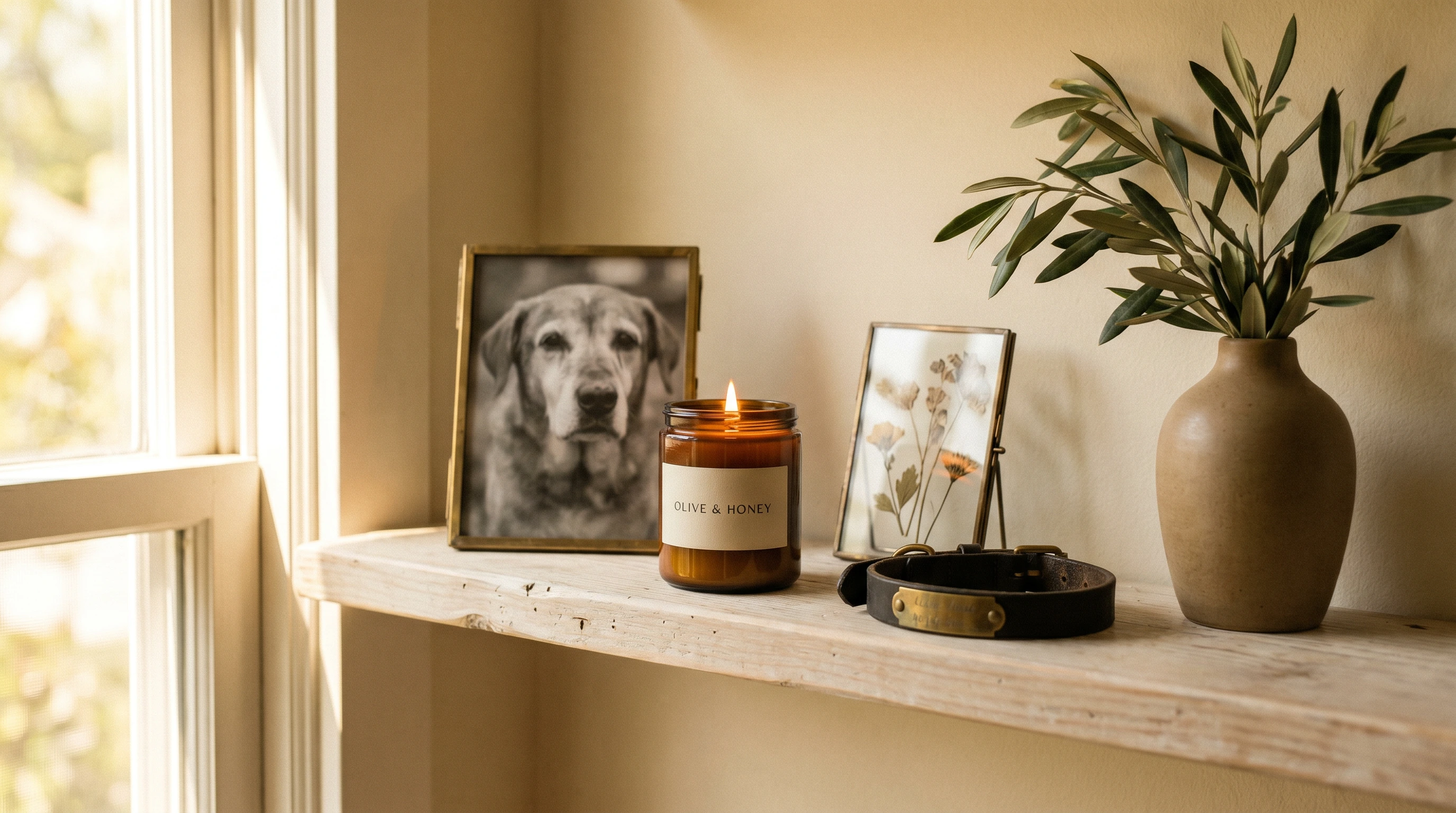
A small home altar
Not religious unless you want it to be. Just a small flat surface — a corner of a bookshelf, the top of a dresser, a windowsill — with three things on it.
A photograph of him. A candle. One object that was his.
That's it. Three things. You light the candle on Sundays, or on the day you lost him, or whenever the house feels too quiet. The altar is a place to put the feeling down for a few minutes when it's heavy. Then you blow the candle out and go on with the evening.
Resist the urge to add more. Three things is the discipline. More than three becomes clutter, and clutter is not what this is for.
Donate to a shelter in his name
A check, once a year, to the shelter you adopted him from. Or to a rescue that pulls dogs of his breed. Or to your local humane society. In his name.
Many shelters will send a small acknowledgment card. Some will name a kennel after him for a month. None of this matters except that it is one of the ways the love he gave you turns into something good for a dog who is currently scared and cold.
If money is tight, the donation can be your time. Walk dogs at the shelter for two hours on a Saturday. The dogs who need to be walked the most are usually the senior dogs no one else wants to spend time with. You will know what to do with them.
Write the letter
The letter you never sent. The one to him, or about him, or to yourself about what he was.
Sit down on a Sunday afternoon with a piece of real paper and a pen. Write him a letter. Tell him what you didn't get to tell him. Tell him about the last day, or about the day you brought him home, or about the time he ate the loaf of bread off the counter and you couldn't be angry. Tell him you're sorry for the time you snapped at him for shedding on the couch. Tell him thank you.
Then fold it. You don't have to do anything with it. You can put it in a drawer. You can put it in the box with the collar. You can burn it in the fireplace. You can read it once a year.
The point is not the letter. The point is the writing of it. Something happens, in the hour you spend writing it, that does not happen any other way. People who have done it say the same thing afterward. I didn't know I was carrying that.
A small last thing
You don't need to do any of these. You don't need a tree or a bench or a painting or a charm. Your love for him does not require a monument. He didn't ask for one. He asked for dinner and a walk and a place on the bed.
If you do nothing — if you just keep his collar in a drawer and don't get another dog for a while and let yourself be sad on Sundays — that is enough. That is, in fact, what most people end up doing, and there is nothing wrong with it.
But if you find yourself in month three, restless, looking for something — try one. Just one. Plant the tree. Or get the photograph framed. Or write the letter. See if it helps.
If it doesn't, try another one next month.
He is not going anywhere. He is in the corner of the couch and on the kitchen floor at four in the afternoon and at the foot of your bed. You can take your time about this.
If a painting on the wall is one of the things your hand reaches for, (here's what those are), and we make them in a small studio when it's the right thing for the family.
But one is enough. Whichever one you choose is the right one.