The best memorials are the ones you still look at when no one else is in the room.
If you search "dog memorial ideas," you get fifty articles that are mostly the same article. Urn-shaped jewelry. Paw-print kits. Stones engraved with his name. Heart-shaped lockets and angel-wing pendants and little glass orbs you're supposed to hang in a window. A lot of them are written for people who haven't actually had to do this, and it shows — the tone is cheerful, the products are on sale, and somewhere in the middle there is always a sentence about "celebrating their life" that uses too many exclamation points.
This is not that list.
This is for someone who has actually had to bury a dog, or scatter him, or carry the small box home from the vet, and who is now sitting with the question of what to do — not on day one, and not for the gift store, but for the next twenty years. What to make. What to keep. What to do on the anniversary, when you have forgotten what day of the week he died but your body has not.
Ten ideas, ordered roughly from the quietest and cheapest to the most permanent. None of them require an urn. Some of them cost nothing. None of them are going to fix the empty spot on the rug. They are not supposed to. They are supposed to give the love a place to live now that he isn't there to receive it.
1. Keep one object, not all of them
The instinct, especially in the first week, is to keep everything. The collar, the tags, the leash, the four toys, the brush with his hair in it, the food bowl, the bandana. Some of that is the right move for week one — don't throw anything away yet — but over time, most families find that one specific object becomes the object. Usually small. Usually unexpected.
For some people it's the tag. For some people it's the collar, kept in a drawer, taken out every so often, smelled. For one person I know, it's the little plastic clip from the end of the leash, which she keeps on her keychain for fifteen years and counting.
Pick the one object that, when you hold it, feels like him. The rest can be kept in a box in a closet, given away when you're ready, or quietly let go of by the version of you who exists in a few years. The one object is the one that matters. You will know which one it is in about six months.
2. The walk you keep doing
This is not a tribute you make. It is one you do.
There is a route you used to walk with him. Most days. The one with the bench he liked, or the corner where he always stopped, or the stretch of grass that smelled like something. Keep walking it. Once a week, once a month, whatever you can do.
The walk is not for him. It is for the version of you that walked with him. It keeps a piece of that geography alive in your body. Years later, you will still be the person who walks the loop, and you will not always think of him on it, and that will also be okay. He shaped how you move through the neighborhood. Let him keep doing that.
3. A meal on the anniversary
Pick the date. Or pick a date near it — the one that feels right, not necessarily the calendar one. Once a year, cook the meal you used to cook on Sundays. Set a place. If he had a favorite human food — a piece of chicken, a corner of the cheese, the heel of the bread — put a small piece on a plate.
Eat slowly. Don't make it a thing. Tell one story out loud if anyone is there. If nobody is there, tell it anyway.
This is the ritual that grieving families come back to most reliably, in the long run, because it is the easiest to keep. A meal is something you were going to have anyway. Once a year, you make it his. After about five years, you will notice that the day stops being a day of dread and starts being a day of quiet remembering — and the meal is part of why.
4. Scatter ashes somewhere he loved
If you have his ashes, and you don't know what to do with them, you do not have to decide quickly. Some families keep them on a shelf for a year before they're ready. That is fine. Ashes do not have an expiration.
When you are ready, pick the place. Not the dramatic place — the actual place. The trail behind the house. The corner of the yard where he sunbathed. The beach he ran on once when he was four. The patch of woods where he found the rabbit. Take someone with you, or go alone. Do not make a speech.
A handful at a time. The wind will do what the wind does. There is no clean way to do this and you will probably cry, and some of it will end up on your shoes, and that is exactly right. He was a real dog. This is a real moment. You don't owe it any kind of polish.
5. The letter you don't send
Sit down with a pen and a piece of paper — not a screen — and write him a letter.
Tell him the thing you didn't tell him. Tell him about the day he died. Tell him about the night you slept on the floor next to him. Tell him about the dog you are now thinking about getting and whether you feel guilty about that. Tell him about the empty hour. Tell him he was the best dog.
Don't edit. Don't reread. Fold it. Put it in a drawer with the collar, or burn it in the backyard, or bury it under the tree you plant. The point is not the letter. The point is the hour you spent saying the thing out loud, in writing, to him.
Some families do this every year. Some do it once and never again. Either is enough. The first one is the hardest. After the first one, you will know whether it is a thing for you or not.
6. A donation in his name
A check to the rescue where you got him. A donation to the shelter in town. A monthly amount to a senior dog rescue, which most cities have, and which take in the dogs that are hardest to place — the eleven-year-olds, the ones with the bad hips, the ones whose people died.
Make it small enough that you can keep doing it. Twenty dollars a month for ten years is a much better tribute than five hundred dollars once. And the rescue will, in many cases, send you a card or a name, and you will know that somewhere, an old dog is on a couch tonight in part because of him.
If you can't afford money, give time. A senior dog rescue near you would take a Saturday afternoon. The dogs are old and they are slow and they need a person to sit next to them. You are exactly the right person for that.
7. A photograph at eye level
Not on the gallery wall. Not in the album you'll open twice. One small framed photograph, at the height where you used to look down at him, in a place you walk past every day.
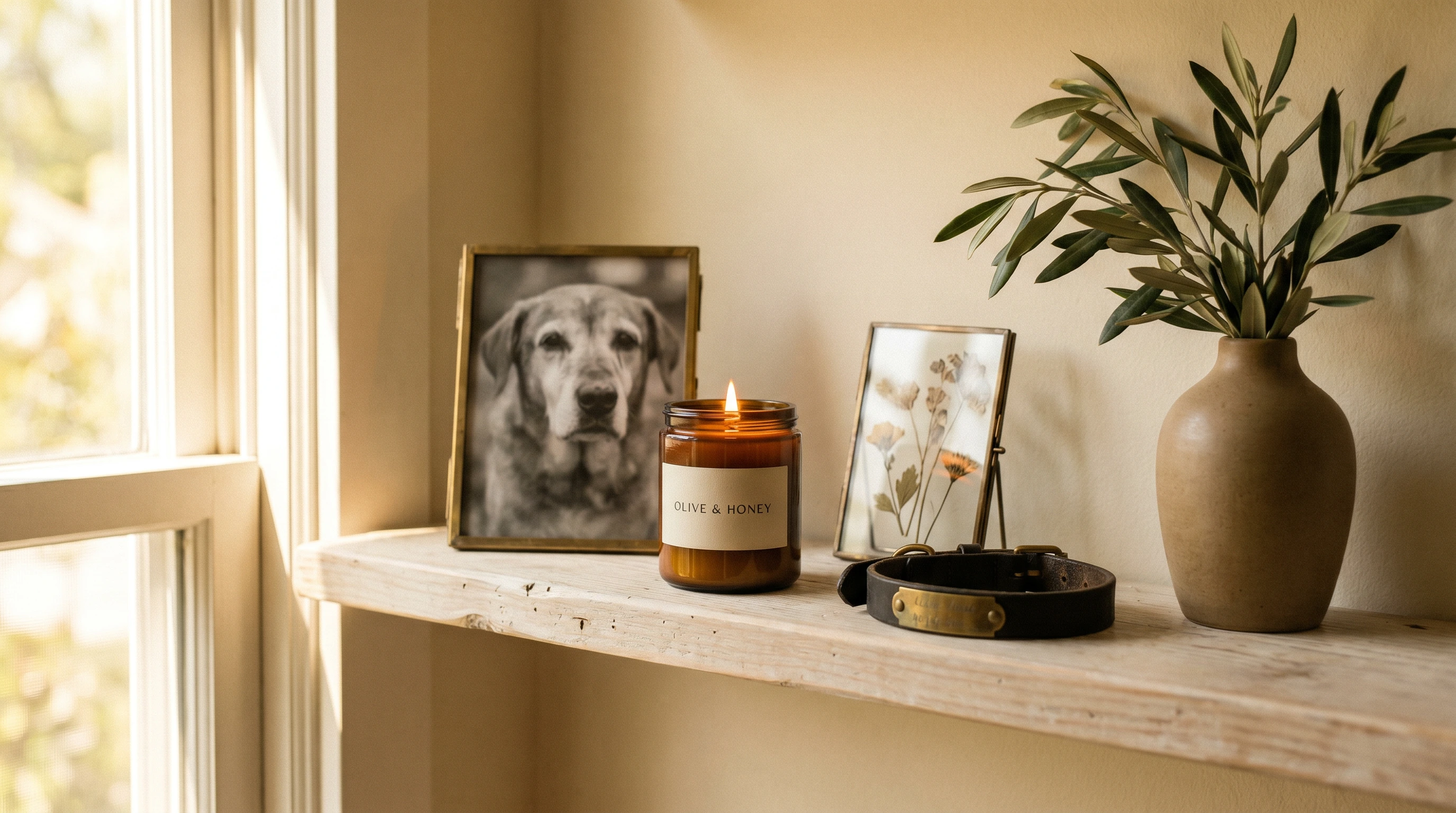
For most people that's the bookshelf in the hallway, or the kitchen counter near the window, or the wall by the back door where the leash used to hang. The point is not to look at it on purpose. The point is to catch it out of the corner of your eye while you're doing something else, and have a small, quiet half-second of him every single morning.
This is the one almost everyone ends up doing eventually. It costs almost nothing. It works. Pick a photograph where he is being himself, not posing for one. Those are the ones you can keep looking at. (How to pick the right photo →)
8. A paw-print impression in clay
If you have one already — one of the air-dry clay impressions the vet sometimes offers at the end — you know what a strange and important small object it is. If you don't have one yet, and it's still possible to get one, ask.
If your dog has already passed and you didn't get a print, the vet who saw him may still be able to help. Some keep records. Some don't. It is okay to ask. It is also okay to not have one. A paw print is not the only way.
If you do have one, frame it. Don't leave it in the box from the vet. A shadow box, a small wooden frame, the kind of thing you can hang somewhere small. The print is one of the only physical objects in your house that he made himself. That matters more than the materials it's made of.
9. A commissioned painting from your favorite photograph
One painting. Done well. From the photograph you already have of him — the one on your phone, the one you look at when nobody's watching.
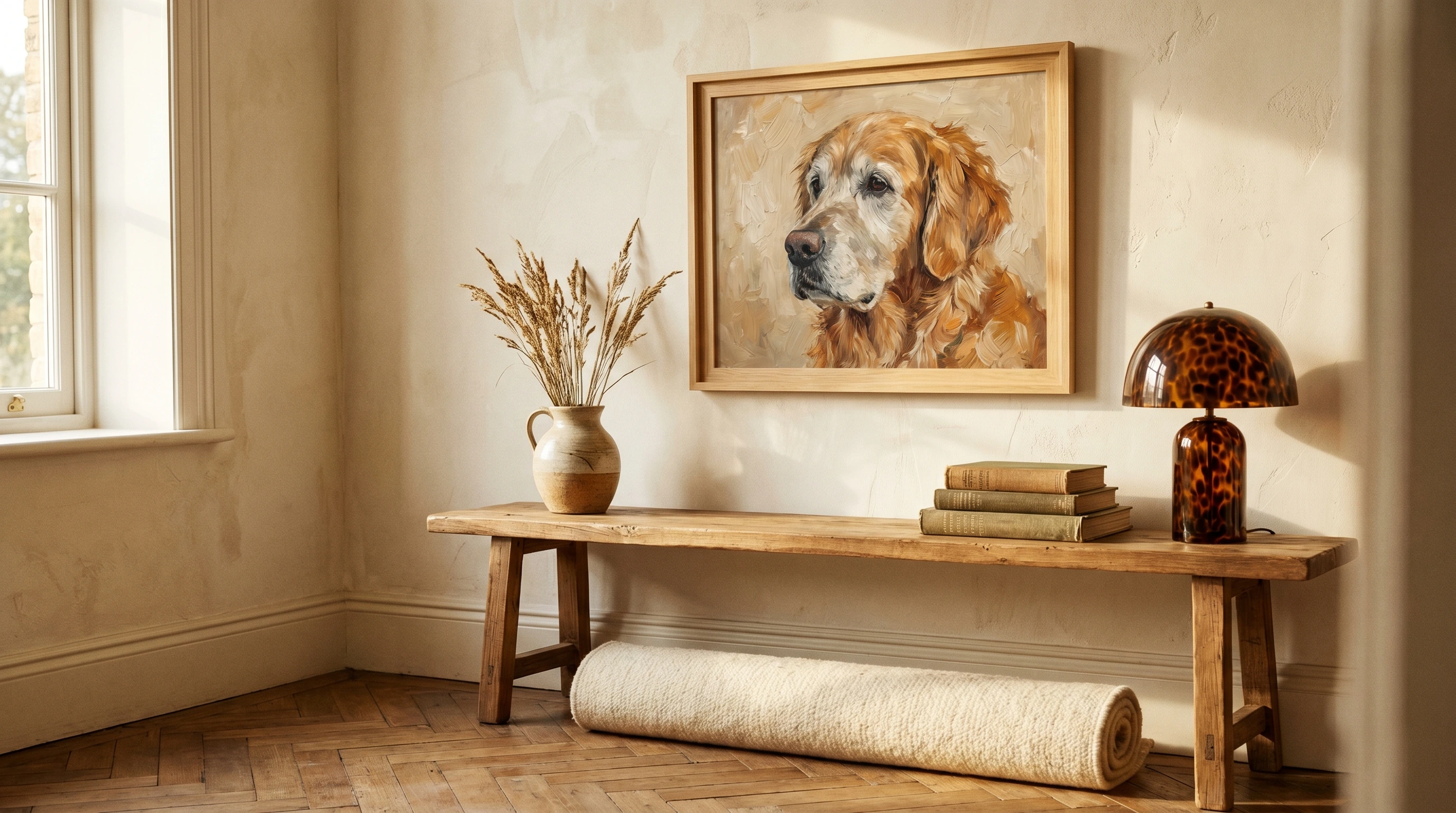
A painting is not a souvenir. It is the thing that stays on the wall after the bowl is gone, after the bed is gone, after the smell on the blanket has faded. It is what your sister sees when she visits in 2034. It is what your grandkids ask about. It is what stays.
It is also slow, on purpose. A real one takes a few weeks. It gets reviewed by someone who knows what they're doing before it gets sent to you. The version that ends up on the wall is one you will be able to look at every morning for the rest of your life without it feeling cheap. We make these, in a small studio, from a single photograph. (Learn how it works →)
10. A bench, a brick, a tree with his name
This one is the biggest and the most public. Many parks, dog parks, botanical gardens, and nature preserves have programs where you can name a bench, a brick on a path, a tree, a tile on a memorial wall.
It costs more than a donation. It is also permanent in a way the others are not. There is something good about a bench with his name on it that strangers sit on every day. Somebody you don't know will rest there. They will not know who he was. They will read his name. That is its own kind of remembering — the kind that doesn't require you to be there for it to keep happening.
If you have a local park or trail he loved, ask. Most cities have a program. Most are small enough that the staff will help you pick a good spot. The plaque doesn't have to say much. His name. Two dates. Maybe one short line. The bench will say the rest.
—
A note on the line tattoo, which a few people ask about and which didn't quite make this list: if you're thinking about it, wait six months. Not because it's a bad idea — for some people it's the right one — but because the impulse to make a permanent mark in the first month is loud, and the version of you in six months will pick a better line. The good ones look like nothing to a stranger. They look like everything to you. That's the right ratio.
There is no version of any of these that brings him back. You already know that. The point is not to fill the empty spot on the rug. The point is to give the love that has nowhere to go, somewhere to go.
Pick one. Or pick three. Or pick none, and just keep the collar in the drawer. They are all the same answer to the same question, which is: how do I keep him here, in some small way, when he is not here.
You already are. You just have to decide what shape it takes.