There is no version of this where it doesn't hurt. There are only versions where you are less alone in it.
I don't know when you're reading this. Probably late. Probably in a quiet house. Probably with the empty spot on the rug right where it always was.
I'm sorry. I am so sorry.
I know we don't know each other. I know a stranger on the internet is a strange person to hear from in the first week. But I have been where you are, and a few of the things I wish someone had said to me — quietly, without trying to fix any of it — I want to try to say to you.
—
For the first night
The bed is going to smell like him for a while. Don't wash it. Not yet. Some people will tell you to. Don't.
You are going to keep listening for him. You will think you hear his nails on the floor. You will swear you heard the tags. You will turn the corner into the kitchen and your body will brace itself to step over him, the way it has for years, and he won't be there, and your body will not know what to do with that.
That is your hearing remembering. That is your spine remembering. It is going to keep happening for weeks. It is one of the strangest, most physical parts of this, and nobody warns you about it.
It is not you going crazy. It is twelve years of muscle memory unwinding.
—
For the bowls
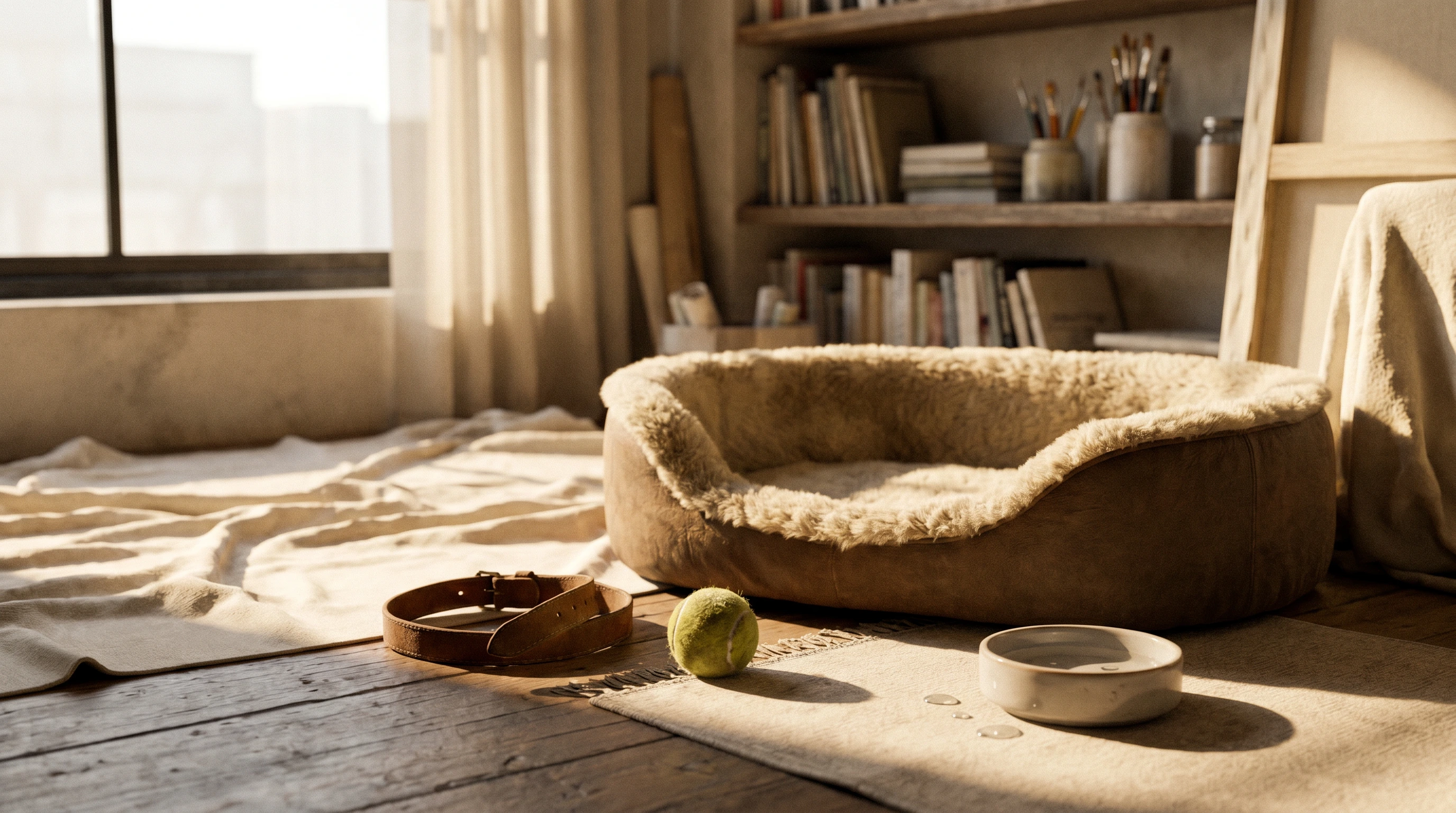
You don't have to put them away. You don't have to leave them out. There is no right answer. The water bowl by the back door, the food bowl on the mat — they will feel like a question every time you walk past them. Either keeping them or moving them will hurt. Pick the one that hurts in the way you can stand right now.
Some people put the bowl in a cupboard the same day. Some people leave it for a month. Some people leave it forever and pour fresh water into it on the bad days, and that is not weird, and it is not pathological. It is one of the ways grief lives in a kitchen.
—
For the people who say the wrong thing
Someone will say "he was just a dog." Someone will say "you can get another one." Someone will say "at least it wasn't a person." Someone will, with what they think is kindness, say "he's in a better place." Someone — and this is the one that hurts the most — will not say anything at all.
You do not have to argue with any of them. You do not have to educate them. You do not owe them a conversation about why this is the same as losing a person who slept in your bed and waited for you every day for twelve years.
Say "thank you." Walk away. Cry in your car. Text the one friend who knew him.
The people who loved him will know what they lost when they lost him. They will be the ones who text you on the actual hard days — the third Sunday, the morning of his birthday, the random Wednesday in April. Hold on to those people. Let the others say what they say.
—
For the guilt about the last day
You are going to relitigate it. Every decision. Every minute. Whether you waited too long. Whether you didn't wait long enough. The food you didn't give him. The walk you didn't take. The car ride. The vet. The needle. The way he looked at you, or didn't, in the last second.
You are going to play it back and edit it and play it back again, and there will be a version of you in your head insisting you should have known something you couldn't possibly have known.
Listen.
You loved him. You watched him for months. You made the call inside the window of when reasonable, loving people make that call. He was on his bed. He was with you. He was not afraid because you were not afraid — or, if you were afraid, you didn't let him see it, which is the same thing from where he was standing.
You did it right. I know you don't believe me. Read this again in a year.
—
For your hands
Your hands are going to look for him. Reaching down beside the couch. Patting the spot on the bed. The hand that always rested on his head when you were on the phone — that hand is going to keep going for the head.
This is the part of grief that lives in the body. Words don't help much. What helps is letting it happen and not punishing yourself for the missing. The missing is the love with nowhere to go yet. It will find somewhere eventually. Not soon. But eventually.
—
For the food in the cupboard
There is a bag of food. There are treats. There is the half-empty bottle of his joint pills. There is the toy you bought him last month that he didn't really play with. There is the appointment card on the fridge for the checkup that isn't going to happen now.
You don't have to deal with any of it this week. Or this month.
When you are ready — and only when — most shelters and rescue groups will take unopened food and unused supplies. Some will take opened bags too. It will feel like a small useful thing to do on a day when nothing feels useful. But not yet. There is no rush. The bag of food can sit there for as long as it needs to.
—
For the second week
Week one, people check on you. Week two, they stop. This is not because they don't care. It is because the world keeps moving and they assume you are also moving.
You may not be moving. You may be worse in week two than week one, because week one was shock, and week two is the realization that this is the new shape of every day. The morning walk that isn't a walk. The coming home to a house that doesn't have anyone in it.
If you can, tell one person ahead of time that week two is going to be hard, and to please check on you then, even though it has been longer. They will. They just need to know.
—
For the dog you'll get someday
You may not get another dog. That is okay. You may get one in three months. That is also okay. You may get one in three years and feel guilty about it for some reason you can't name. Also okay.
The next dog, if there is one, is not a replacement. He is not an upgrade. He is not the same dog wearing a different coat. He is a different dog, who you will love differently, and who will not be required to be the one you just lost. This is one of the kindest things you can do for the next dog: not ask him to be the one before.
Some people wait years. Some people, the next week, find a dog who needs a home and bring him home that day and cry for both of them at once. There is no schedule. The dog you lost is not measuring you against it.
—
For the small things you'll keep
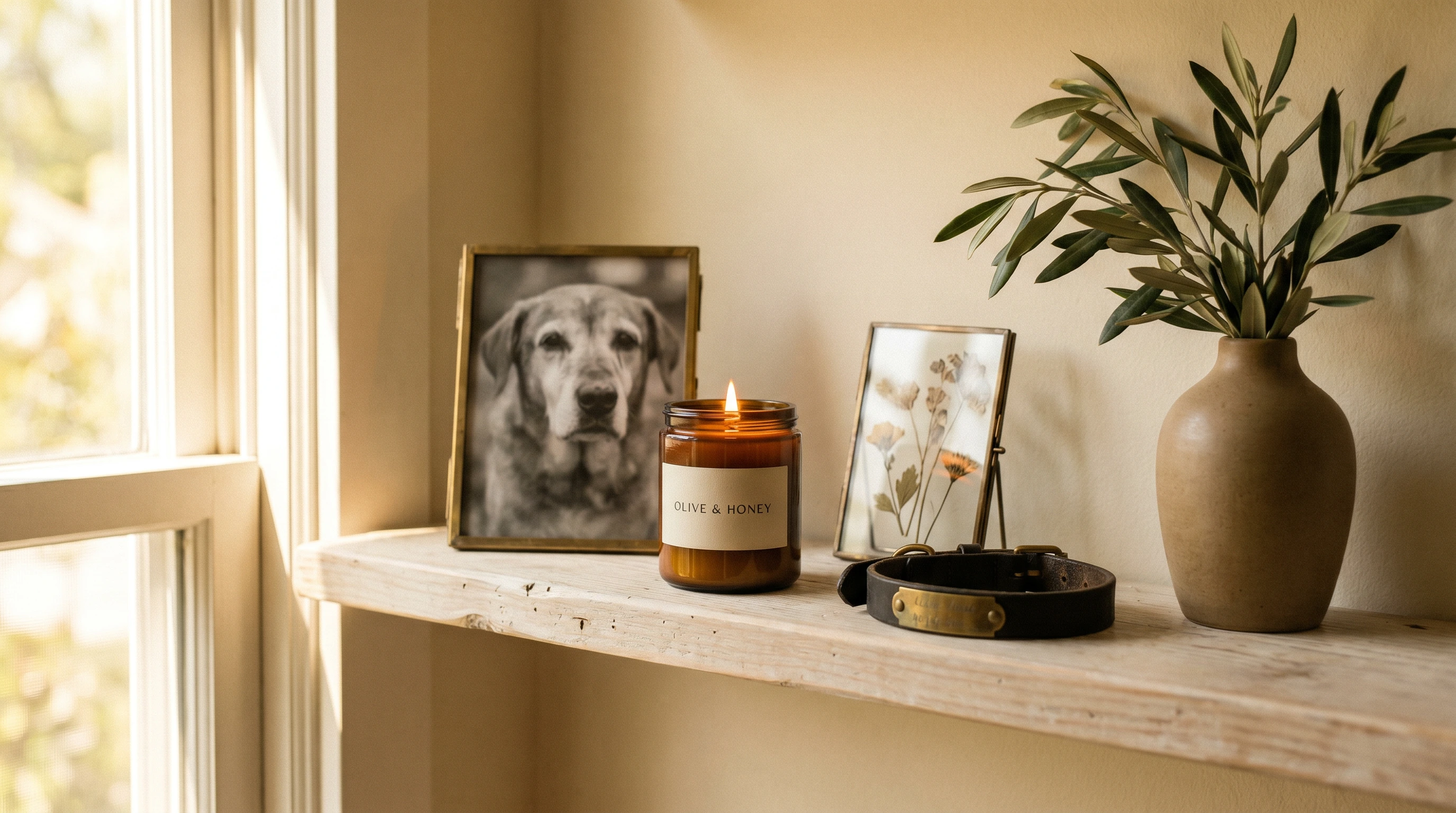
A collar. A tag. A bowl. A blanket. A photograph. The little metal vaccination tag from 2014. The leash with the worn handle. The bandana from the groomer.
Put them in a drawer. Don't decide right away what to do with any of it.
In a year, some of it you will want to see every day, and some of it you will want to put away, and some of it you will lose track of, and one piece of it — usually a small one, usually one you didn't think mattered — will turn out to be the one you keep forever. You don't have to know yet which one.
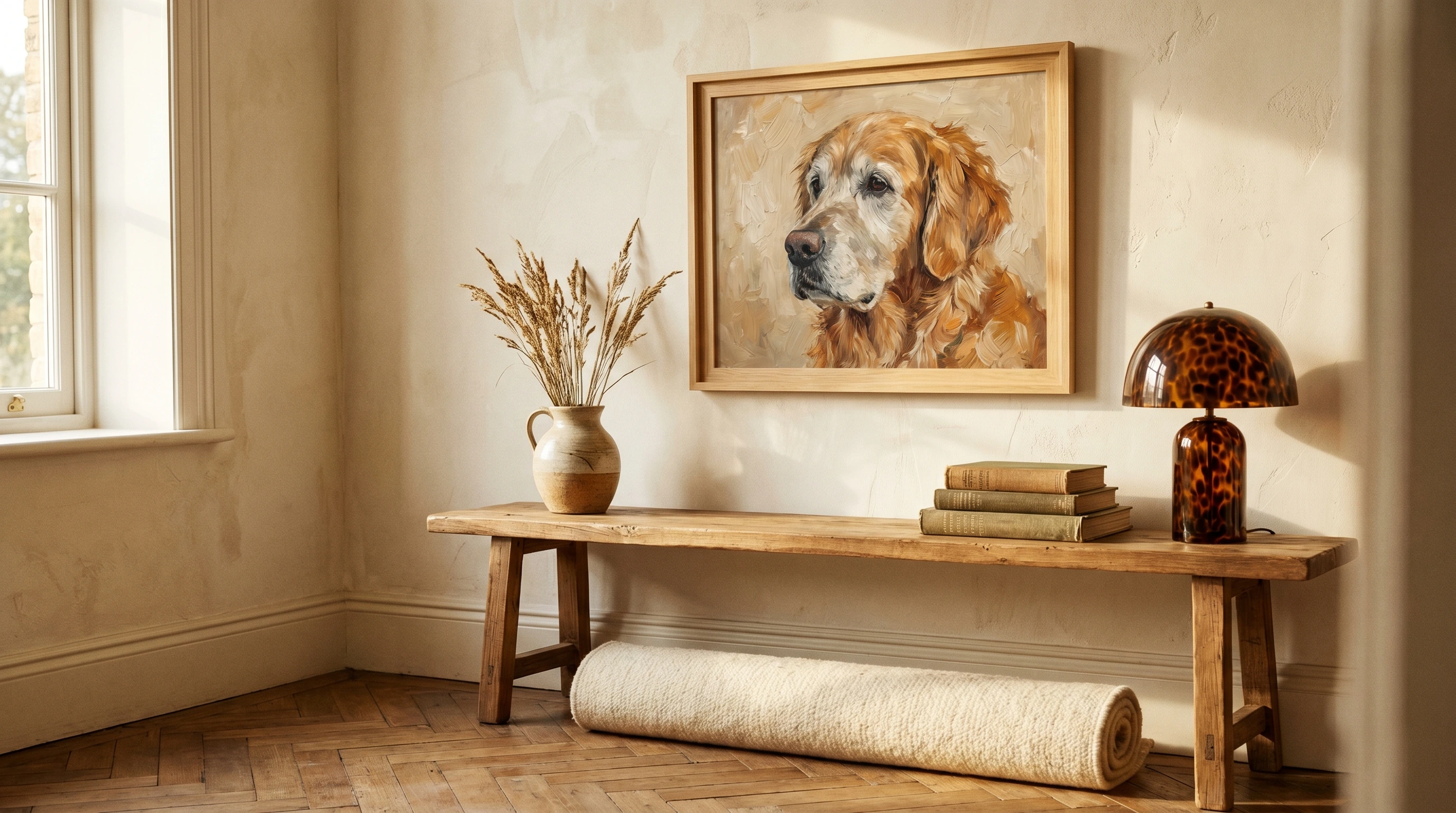
If you want something to look at when the house feels too quiet, that is allowed. Some people plant a tree. Some people put a small framed photograph on the bookshelf at the height where they used to look down at him. Some people commission a painting from a favorite photo, and put it in the hallway, and walk past it every morning. We make those, in a small studio. People order them in the first week and people order them ten years later. There is no right time for any of it.
—
For the empty hour
There is going to be one specific hour of the day that's the worst. For most people it's the morning walk. For some it's six o'clock, when the bowl used to come out. For some it's the moment you get home from work and nobody comes to the door.
When you find your hour, name it. Tell someone. Plan, on the worst days, to be somewhere — a friend's, a walk, the car, anywhere — during that hour. Or sit with it on purpose. Either is fine. The hour will get a little quieter over time. Not less true. Just quieter.
—
For now
You are not crazy. You are not weak. You are not "too sad about a dog." You loved someone for twelve years who slept by your feet every night, and he is not there anymore, and your body has not caught up to that yet.
Be gentle with yourself this week. Eat something. Sleep when you can. Cry in the shower if you need to. Tell the one person. Leave the bed unwashed for a little while.
He knew. The whole time. He knew exactly how loved he was. That doesn't fix any of this. But it's true, and on the hardest night of week one, it is worth saying out loud.
I am so sorry. He was so lucky it was you.