Grief that arrives early is not weakness. It is the cost of loving him this long.
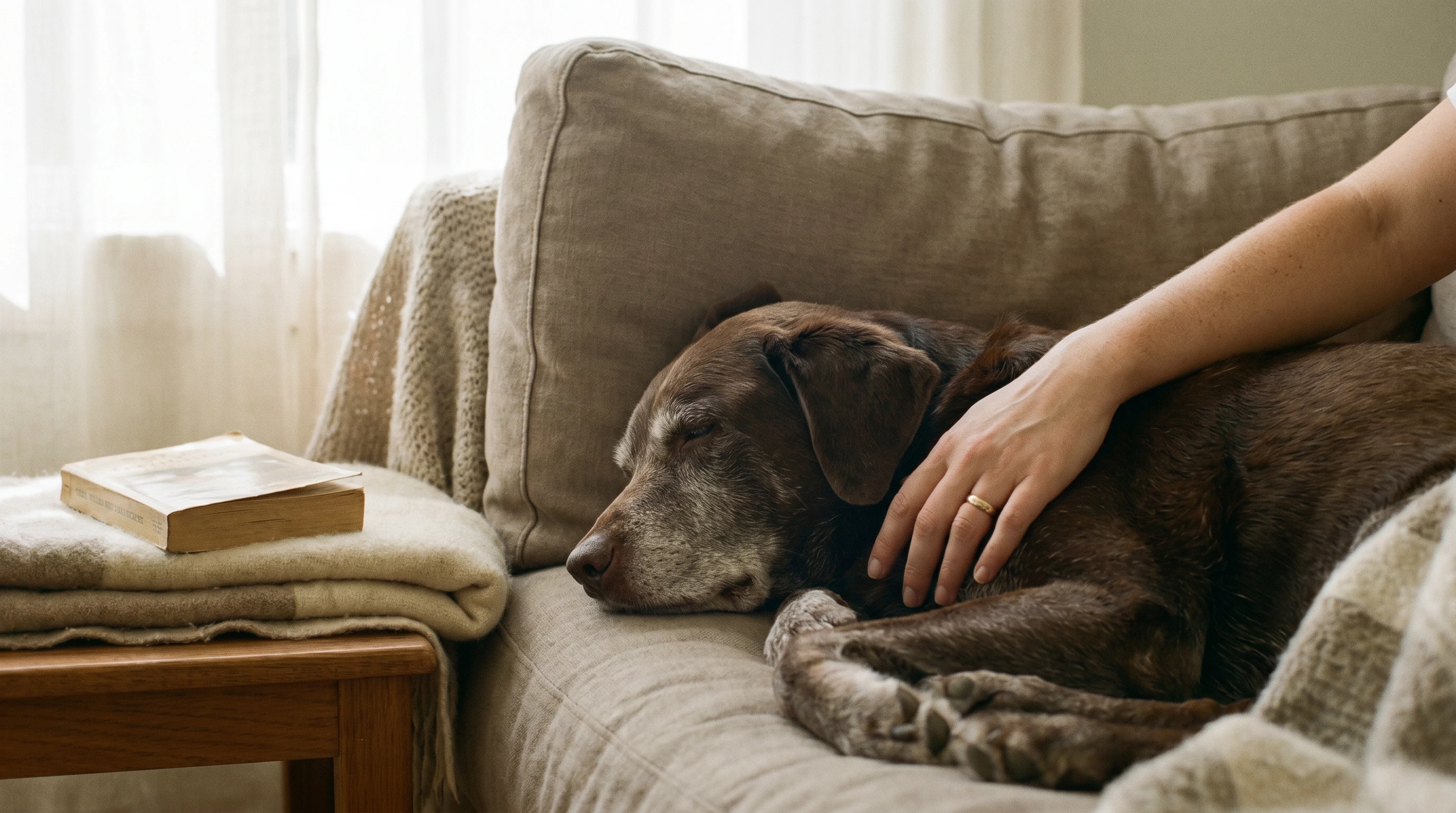
You are sitting on the kitchen floor at ten at night, and he is asleep on his bed three feet away, and you are crying without making any sound. He is still here. That is the part that doesn't make sense to you. He's breathing. You can see his side moving. And you are mourning him anyway.
There is a name for what you are doing. It is called anticipatory grief, and it is one of the least talked-about parts of loving an old dog.
What it actually is
Anticipatory grief is the grieving you do before the loss. Not instead of the grief that comes after — in addition to it. You are mourning a dog who is still here, while you are also trying to take care of him, while you are also trying to keep going to work and making dinner and answering texts like a person who is not, in the background of every single thing, doing math about how many months are left.
Hospice workers see it all the time in families. Veterinarians who do end-of-life care see it. Lap of Love, the national network of in-home hospice vets, has written about it for years — the family member who is the most exhausted is often the one who started grieving six months before the dog did.
It is not in your head. It is not premature. It is what attentive love does when the thing it loves is slowly leaving.
How it shows up
It almost never shows up as a dramatic, sit-down sadness. It shows up sideways.
You start crying in the car for no reason. A commercial gets you. A song that has nothing to do with him gets you. The dog food aisle gets you. You can't watch him sleep without your chest tightening — you keep checking that he's breathing. You find yourself avoiding looking at him too long, and then feeling guilty about that, and then looking at him too long and crying.
You start narrating his life to yourself in the past tense, by accident. He used to love that park. He still does. He went on Tuesday. But your brain has started archiving him while he's still on the rug.
You stop making plans more than two weeks out. You don't want to book the trip. You don't want to commit to the wedding. You don't want to talk about September. You are not being avoidant. You are protecting your ability to be home.
You wake up at three in the morning and lie there counting his breaths. You take more pictures of him than you used to. You watch him eat with a particular attention. You find a gray hair on his muzzle you hadn't seen before and you sit with it for a minute.
If any of this is you — you're not unwell. You're paying attention.
Why this is harder than people think
Most grief, when it arrives, gets to be grief. People bring food. Friends call. You get a few weeks where the world treats you gently because something happened.
Anticipatory grief gets none of that. Nothing has happened yet. Your dog is alive. From the outside, everything looks fine. You are supposed to be grateful for the time. You are grateful for the time. You are also exhausted, and scared, and already in mourning, and there is nowhere to put any of it because the loss hasn't given you permission yet.
And you are caretaking at the same time. You are giving the pills. You are carrying him up the stairs. You are sleeping on the floor when he can't make it onto the bed. You are doing the math on how much one more vet visit costs and feeling guilty for doing that math at all. The grief and the work are happening in the same body, on the same Tuesday, and there is no shift change.
People who haven't lived inside this don't understand why you sound so tired.
What makes it worse
A few things make it harder than it already is.
Suppressing it. Telling yourself you can't cry yet because he's still here. Saving the grief for later, like it's a thing with an expiration date. It doesn't work. The grief comes anyway, at the wrong times, in larger doses, and you end up exhausted instead of sad.
Isolating. Not telling anyone what's actually going on because you don't want to be the person who's already crying about a dog who is still alive. Sitting alone with it makes it grow.
Trying to make every day count. This sounds kind. It is, in practice, a kind of low-grade panic. The pressure to make every walk meaningful, every dinner special, every photograph perfect — it turns the time you have left into a performance instead of a Tuesday. He doesn't need a special Tuesday. He needs his Tuesday.
Pre-deciding how you'll feel. Telling yourself you'll be fine. Telling yourself you'll be wrecked. You do not know yet. Let the actual day be the actual day.
What helps
There are a few things, said quietly by families who have been through it, that seem to help.
Name it, even just to yourself. Saying I am grieving him already and he is still here out loud, alone in the car, does something. It stops the feeling from being unaccountable. It makes it a known thing, with a name, that other people have also had.
Tell one person. Not everyone. One. Someone who has had a dog and lost him. Someone who won't say "but he's still here, you have time." Someone who will say "yeah. I know." That one person being able to hold the feeling with you means you don't have to carry the whole weight of pretending.
Build a small daily ritual. Five minutes. Same time every day. A hand on his side while you drink your coffee. A walk to the corner and back, even if he doesn't want to go far. The point isn't to make a memory. The point is to give yourself a place to put the feeling that doesn't require you to fall apart.
Take the photographs now. Not for an album. Not for Instagram. For you, in five years. Get down on the floor. Get his face. Get his paws. Get your hand on him. There is no version of the future where you regret having too many photographs of him. (How to photograph a senior dog →)
Let yourself look at him. All the way. Not the way you look at a thing you're losing. The way you look at a thing you love that is right here. The grief is not going to be smaller if you don't look. It will be smaller if you do.
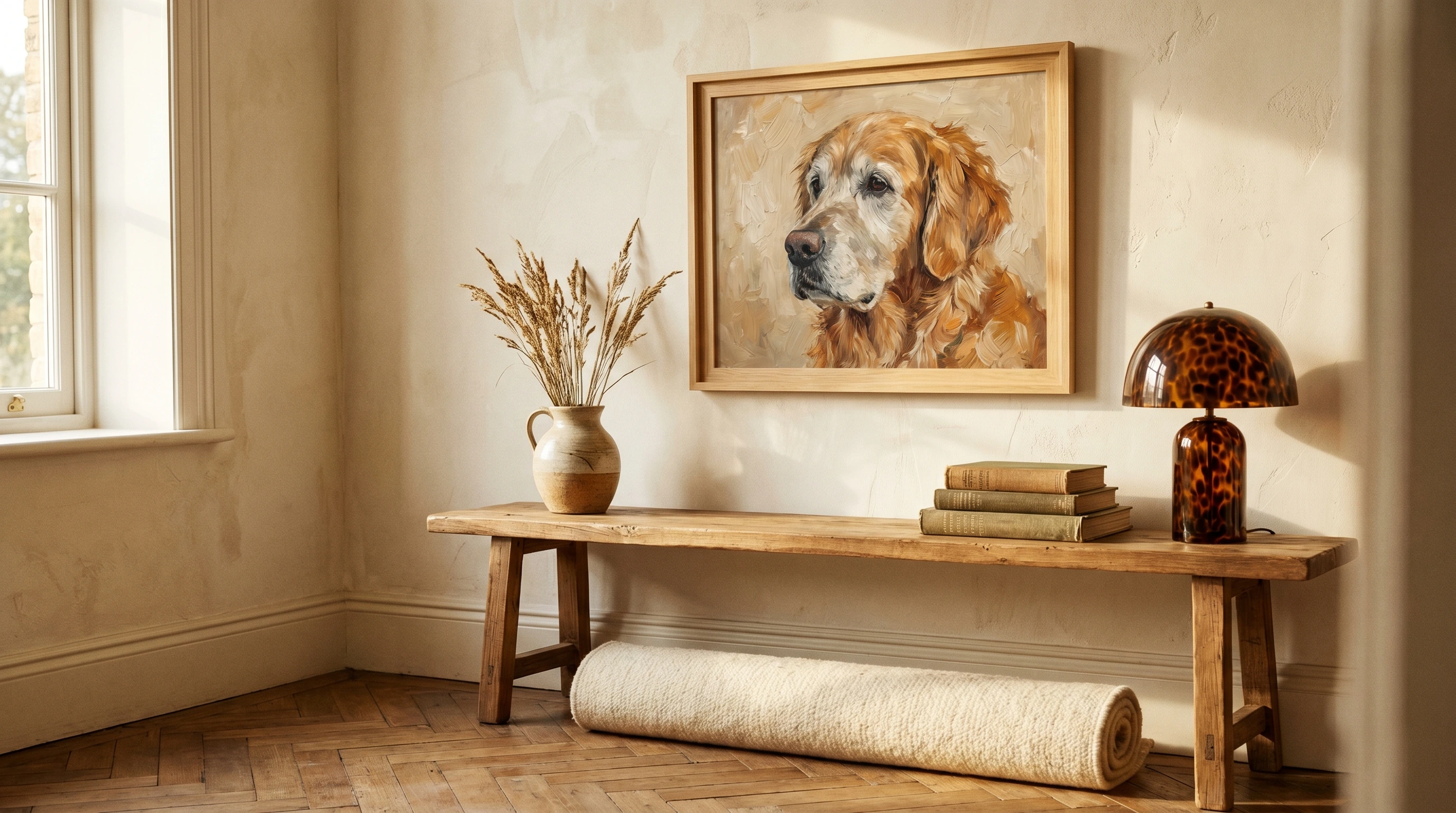
Do one meaningful thing while he's here, not after. A lot of families wait until after to commemorate their dog — and then spend months wishing they had started while he was still around. A photo book ordered now. A walk with the person who knew him from the beginning. A portrait commissioned from a good picture, so he can see it on the wall too. The meaningful thing does not have to be expensive or large. It has to happen before, not after.
A commissioned painting is one of the things we do here, in a small studio, from a single photograph. People order them sometimes while their dog is still on the rug and sometimes after. There is no right time for that. But if it is something you have been thinking about, doing it now means he is part of it. (Learn how it works →)
On the guilt
You are going to feel guilty for grieving him while he's still alive. Like you are giving up on him. Like you are mourning him too early and somehow speeding up the clock.
You are not. The grief did not cause anything. It is the response of a person who has been paying attention, to a body that is changing, in a dog that is loved. You can grieve him and still be all the way present for him. In fact — and this is the part nobody tells you — the people who let themselves grieve early are often the ones who are most fully there at the end. Because they have already done some of the looking.
And then
At some point, the anticipatory grief will end. Not because the feeling resolved, but because the loss arrived, and a different grief took its place. The new one will be harder in some ways and, strangely, simpler in others. There will be nothing more to anticipate.
In the meantime, the dog is still on the rug. He is breathing. He is looking at you the way he always has. You can grieve him and still be here for him. They are the same thing, actually. They have been all along.