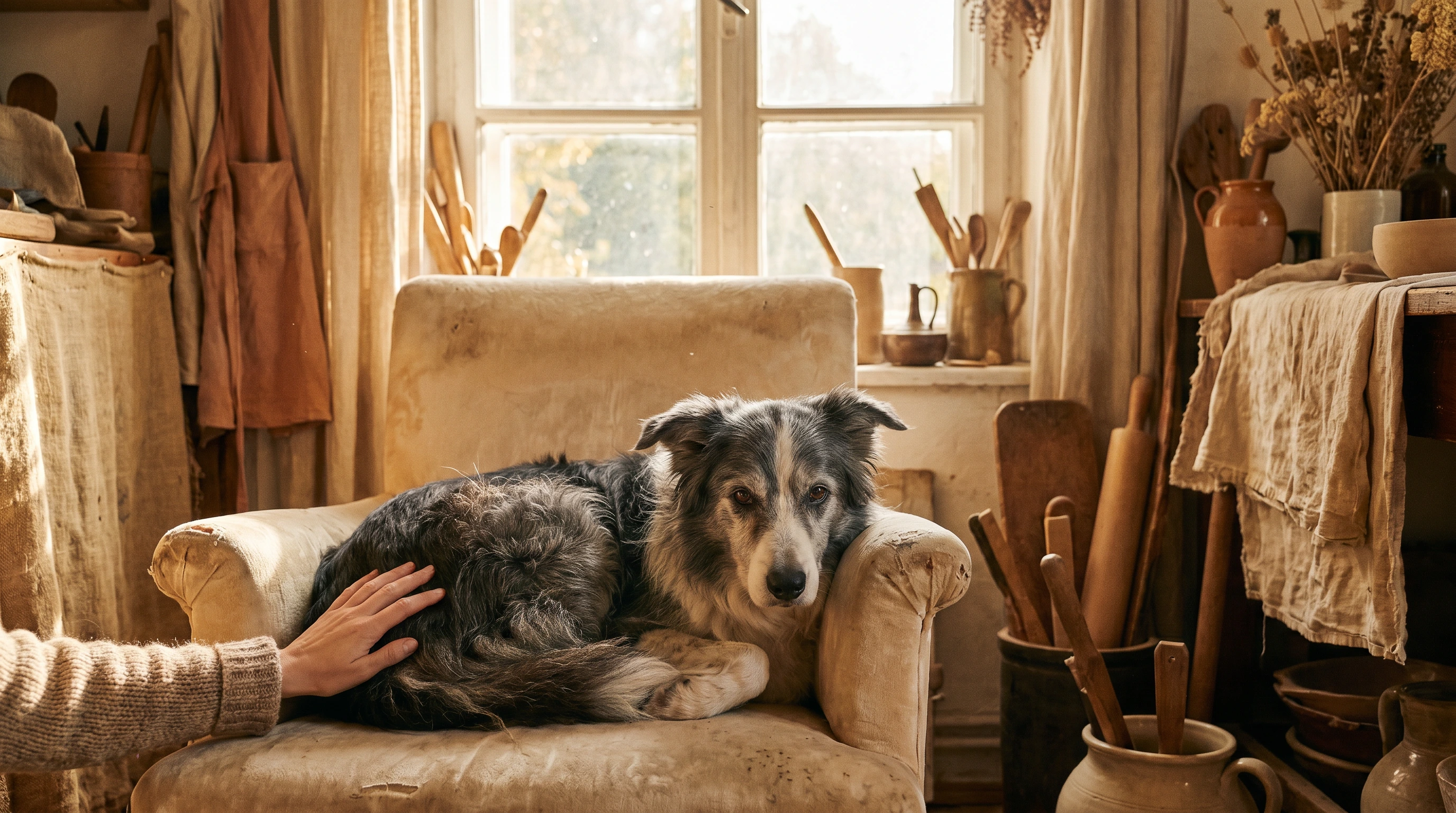
He doesn't need a studio. He needs his couch, his favorite person, and an hour of soft light.
There is a Sunday coming up where the light will be good and he will be having an okay day. Not a great day. An okay one. He'll be on the couch in the afternoon, the way he is, and you'll be making tea, and you'll think — maybe today.
That's the day. That's the whole project. One hour at home, on the couch, with the phone. Not a studio. Not a photographer. Not a session. An hour.
What follows is how to do it well.
When to do it
Now. Not later.
This is the part nobody wants to hear, so it goes first. The lighting will not get better than it is in October, or whatever October is where you live. He will not get more able to look at the camera than he is this week. The version of him that you have today is the version you want to photograph.
People put this off because it feels like an admission. Taking the photographs means saying that the photographs are going to be needed. That is the same wall you've been hitting on every other thing — the vet conversation, the hospice talk, the question of his bed and where it goes after. Take the photos anyway. The wall is there either way.
If he has had a bad week, wait three days for a better one and do it then. Don't wait three months.
Where
His couch. The porch. The favorite rug. The corner of the kitchen where the sun lands at four. The spot at the foot of your bed.
Not a backdrop. Not a clean blank wall you have set up. Not the back garden in front of the rosebush. Photograph him where he actually is, in the spot he actually lies in, on the cushion that has the dent of him in it.
Five years from now, you will not remember the rosebush. You will remember the cushion, and the way the light came in through the kitchen window at four, and you will be grateful you have a photograph of that exact thing.
If you have to move him to a different spot for the light to be better, don't. Move the photographer instead. Photograph him where he is.
How to prepare
Don't.
No bath. A bath is a stressful event for a senior dog and it does not improve the photograph. He looks like a wet dog afterward, slightly miserable, with his fur in unfamiliar shapes. Skip it.
No costume. No bandana, no holiday sweater, no flower crown. He has been your dog for fifteen years without any of that. Don't put a costume on him now.
Brush him gently if his coat is matted. Comb his face with your fingers — the fur around the eyes and the muzzle. Wipe the tear stains under his eyes with a damp washcloth. That's it.
No treats that get him excited. A senior dog who is wound up about treats is panting, drooling, restless. The photo you want is the quiet one. If he needs anything, a small piece of cheese after, as a thank-you. Not during.
Put him in his normal spot. Let him settle. Give him five minutes to forget you have a plan.
The light
Late afternoon. The hour before the sun goes down. Almost any window in a house, at that hour, gives you light a portrait photographer would pay for.
If you can choose between windows, choose a north-facing one. The light is softer and steadier — no direct sun, no harsh shadows. If you don't have a north window, any window in late afternoon will work. Mid-day light through a south window can be too bright; close the sheer curtain if you have one to diffuse it.
Put him so the window is to one side of him, not behind him. Half his face lit, half in soft shadow. That's the painter's light. That's how the old portraits were made.
Turn off the overhead light. Turn off the lamps. The mix of yellow lamp light and blue window light makes the camera unhappy and gives him a strange cast — orange in places, blue in others. One source of light only. The window.
If the room is too dim, open another curtain, open the front door, move him closer to the window. Don't reach for the flash. Never the flash.
What to wear
You are going to be in some of these photos. Your hand at least. Maybe your arm. Maybe your lap if he likes to put his head there.
Wear something soft. A worn sweater, a flannel shirt, an old cotton t-shirt. Not stiff, not bright, not the new red top that catches the eye and competes with him for attention. Neutral. Cream, oatmeal, soft gray, navy, faded denim. Something he has leaned on a thousand times.
Get your hand in the photos. The hand on his side. The hand on his head. The hand holding his paw. People forget this and they never forgive themselves. The dog alone, in five years, is one kind of photograph. Your hand on the dog is a different kind, and it is the one you will need.
If you wear a wedding ring, leave it on. If your hand has a scar on the knuckle from the gardening last summer, leave it visible. This is a portrait of the two of you. Not a stock photo.
What to photograph
Five things. If you only get these five, you have done the whole job.
His face, close, at his eye level. Get on the floor. Phone held at the height of his eyes. Tap the screen on his eye to lock focus. Make a small noise to get him to look up. Take three in quick succession.
The paws. The pads, the fur between the toes, the curl of the nails. From above, the foot resting on the cushion. Or his paw in your hand. Photograph the hands and the paws together if you can.
Your hand on him. Side of his neck. Top of his head. On his chest where you can feel him breathing. Get someone else to take this if there is someone in the house. Otherwise, prop the phone on a stack of books, use the timer, sit down next to him, put your hand on him, wait for the click.
Him in his favorite spot. The whole scene. The couch with him on it. The window behind. The room as it is, with him in it. Five years from now, the room will be the same and he won't be in it, and you'll want the photo of the room with him in it.
The looking-at-you photo. Eyes meeting the camera. Soft. Present. A small noise — his name, said quietly, or a kiss sound — to get him to lift his head. Take three or four in a row. One will be the one.
If you have any time left after those five, take photos of his profile. Photos of his ears. Photos of the white on his muzzle. Photos of him asleep. None of them will be wasted.
What not to do
Don't make him stand if his hips hurt. The standing photo is not worth the day of stiffness afterward. Photograph him lying down. Lying down is honest.
Don't make him pose. He doesn't know how to pose anymore. The whole point of this hour is that he is being himself. Sitting on his cushion, looking at the yard, sleeping with his chin on his paws. The stillness is what you want.
Don't keep pulling his head up if he wants to put it down. If he is tired, let him be tired. A photograph of him resting his chin on his paws, eyes half closed, is a better photograph than any pose you could make him hold.
Don't drag it past forty-five minutes. An hour is the absolute maximum. He will get tired. You will get tired. The photos will get worse, not better. Stop while you're ahead.
Don't review every photo on the screen as you go. Take a lot. Look at them later. If you stop and squint at the screen after each one, you'll miss the next moment. Trust the volume. You only need one of each.
Don't apologize to him while you're doing it. He doesn't know you are doing anything strange. He thinks you are sitting on the floor with him on a Sunday afternoon, which you are.
A note on hiring a professional
There are photographers who specialize in this. End-of-life pet photography is a real practice, in most cities, and the photographers who do it are unusually kind. They come to the house. They bring nothing but a camera. They spend an hour or two with you, quietly, and they leave you with a folder of beautiful images a few weeks later.
The cost varies — usually a few hundred dollars, sometimes more, sometimes less. If money is not the constraint, it can be the right choice. The photos are better than what you'll get with your phone. The session is also a kind of ceremony, which some families find helpful and others find too much.
You can find these photographers by searching for your city and "end-of-life pet photography" or "in-home pet photography." Look at their portfolios. Choose someone whose photos make you feel something, not someone whose photos are technically perfect but cold.
If you'd rather not have a stranger in the house — and many people would rather not — the hour with your phone is enough. Truly. The technical guide is here: (How to photograph a senior dog →).
After
When you are done, back the photos up.
Email them to yourself before you go to bed. Put them in a folder on a computer that isn't your phone. Print one out at the drugstore tomorrow and put it on the fridge. The photos exist in three places now: your phone, your email, the fridge. They are safe.
Then put the phone away. Sit on the couch with him. Don't take any more photos for the rest of the night.
This hour, even if every photo is blurry, even if the light wasn't perfect, even if he wouldn't look up, will turn out to be one of the best hours you spent together. You will not realize it yet. You will realize it in a year, when you open the folder, and your hand goes to your mouth, and there he is.
He is right there in the corner of the couch. Go take the photos.