The right time to ask about CBD is the week you first notice the limp not going away.
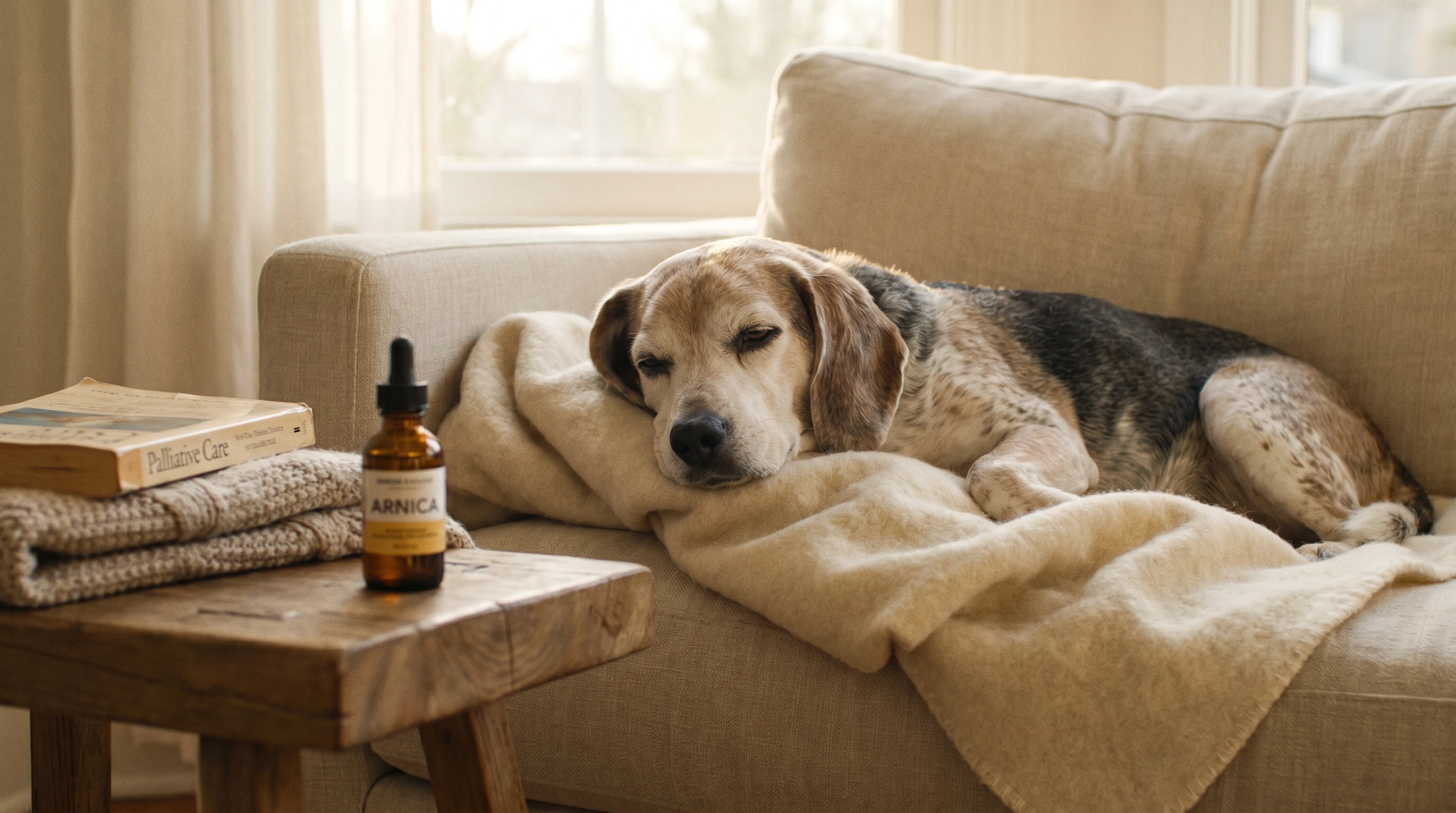
He's twelve. His hips have been bad for two winters now, and the carprofen is doing what it can, but you can tell when he stands up that the first three steps are negotiated. A neighbor at the dog park mentioned she gives her old labrador CBD oil and swears by it. You went home and typed "cbd for senior dogs" into Google and got 4 million results, half of them stores trying to sell you something, half of them vague.
This is the plain version. What it is, what it isn't, what the actual evidence says, how to talk to your vet about it, and how to evaluate a product without getting cheated. No selling. No miracle claims. Just what a friend who reads this stuff would tell you over coffee.
Why people ask about it for older dogs
A few reasons, and they tend to cluster.
Arthritis pain is the big one. As dogs get into their double-digit years, joints stiffen, cartilage thins, hips and elbows ache. NSAIDs like carprofen, meloxicam, and galliprant help, but some dogs can't tolerate them long-term — the liver gets unhappy, or the stomach does. Owners go looking for something to add to the picture, something gentler.
Anxiety is the second. Some older dogs get more anxious as they decline. Storm phobia gets worse. They start panting in the evenings. They pace at night. Cognitive dysfunction — basically dog dementia — adds to it. People reach for CBD the way they'd reach for melatonin for a restless human grandparent.
Sleep is the third. Related to the above. Some older dogs sleep poorly. They get up six times a night. They wander.
Appetite is the fourth, less often. Some owners want to know if it can help a dog eat through nausea, especially during cancer treatment.
These are all reasonable reasons to look into it. None of them are reasons to expect a miracle.
What CBD actually is
CBD stands for cannabidiol. It is one of more than a hundred compounds found in the cannabis plant. The product you'd give a dog is almost always derived from hemp — a variety of cannabis bred to have very little THC, the compound that gets humans high.
THC is bad for dogs. Even small amounts can cause toxicity — wobbling, vomiting, incontinence, in larger doses worse. A good CBD product made for dogs has either zero THC or trace amounts under the federal limit of 0.3%. You will see products labeled "broad spectrum" (no THC, other hemp compounds present) or "isolate" (only CBD). Either is fine. "Full spectrum" includes trace THC and is the one to be most careful with for dogs.
CBD works on the endocannabinoid system, which dogs have — every mammal does. It is involved in pain signaling, mood regulation, appetite, sleep. CBD nudges that system. It does not sedate. It does not get the dog high. At appropriate doses, dogs given CBD behave normally; you wouldn't notice anything was different except, hopefully, that they seemed a little more comfortable.
What the research actually says
This is the part most marketing pages skip, so let's do it carefully.
The strongest evidence is for osteoarthritis pain. Cornell's veterinary college ran a study in 2018 looking at CBD oil in dogs with OA. The dogs given 2 mg/kg of CBD twice daily showed measurable reductions in pain and increases in activity, with no major side effects, over a four-week period. A follow-up study published in 2020 in the journal Pain with a larger sample confirmed similar findings. Baylor College of Medicine ran a separate trial in 2022 that also showed pain reduction.
These are not enormous studies, and they are not a guarantee, but they are real peer-reviewed work showing a real signal. For arthritis specifically, the evidence is the strongest.
For anxiety, the evidence is mixed and weaker. A 2020 study from Waltham Petcare Science Institute found some reduction in stress markers in dogs given CBD before a car ride. Other small studies have shown modest effects on storm and separation anxiety. Some have shown nothing. If your dog has serious anxiety, CBD is not the answer; talk to your vet about trazodone, gabapentin, or behavioral options.
For sleep, the evidence is very mild — mostly anecdotal owner reports. There's no good controlled work showing CBD improves dog sleep specifically.
For appetite during illness, the evidence is mostly extrapolated from human cancer studies. Some vets use it adjunctively. The signal in dogs is small.
The honest summary: there is real, modest evidence for arthritis pain. Everything else is anecdotal, small, or both. If someone tells you CBD will fix your dog's anxiety or extend his life, they are overselling.
The conversation to have with your vet
Have it. Before you order anything.
A lot of owners skip this because they assume their vet will be dismissive. Some vets are. The veterinary profession was officially silent on CBD for years because of regulatory awkwardness. That has shifted. Most vets in 2026 will at least talk to you about it. Some now actively recommend it for OA. If your vet will not engage at all, that is information about your vet.
Bring two things to the appointment.
One: a complete list of every medication your dog is on. Not just the daily ones. The PRN trazodone for storms. The eye drops. The joint supplements. The Adequan injections. Everything.
Two: the bloodwork from his most recent panel. If it's older than six months, get a new one before starting CBD.
Ask your vet four questions.
Given his other medications, is there an interaction I should know about? This matters most for dogs on phenobarbital or other seizure meds, on certain NSAIDs, or with liver disease. CBD is metabolized by the liver — specifically by the cytochrome P450 system — and can affect the levels of other liver-metabolized drugs in the body.
What dose would you start at for his weight? You want a starting number from a vet, not from the bottle.
What should I watch for in the first two weeks? Sedation. GI changes. Anything off.
Should we recheck his liver values in 30 or 60 days? For longer-term use, especially in dogs already on liver-stressing medications, this is the safety check.
If your vet won't have any of these conversations, find a vet who will. Integrative veterinary practices and many holistic vets are deeply versed in this. You don't have to switch primary care — you can consult once.
How to evaluate a product without getting cheated
The CBD market is full of bad products. Some have less CBD than the label claims. Some have more THC than they should. Some have heavy metals, pesticide residue, or random additives.
The number-one thing to look for is a Certificate of Analysis, also called a COA. This is a third-party lab test that shows exactly what's in the bottle. A reputable company posts the COA for the specific batch you're buying, on their website, accessible by lot number on the bottle. If they don't have one, don't buy.
The COA should show four things:
Cannabinoid potency. The actual CBD concentration matches the label. THC is at zero or under 0.3%.
Pesticide screen. Clean.
Heavy metals screen. Clean. Hemp is what's called a bioaccumulator — it pulls heavy metals out of the soil — so a clean screen matters.
Microbial and solvent screens. Clean.
Beyond the COA, a few other things to look for. The product should be made specifically for pets, not just a human tincture marked up. It should contain MCT oil (coconut-derived) or hemp seed oil as the carrier — not random flavorings, not xylitol (xylitol is fatal to dogs; this is the single most important ingredient check). It should be sold by a company that has been doing this for at least a few years and has a real customer service phone number.
Brands that consistently meet these criteria as of 2026 include ElleVet (the brand used in the Cornell study), Honest Paws, Austin and Kat, and a few veterinary-specific brands available through your vet. There are others. The point is not the brand — the point is the COA.
Avoid: gas station CBD. Amazon CBD (Amazon's CBD ban means most products there are hemp-seed oil mislabeled). Anything with a cute mascot and no COA. Anything making cancer claims.
Dosing — the careful version
This is the part where you go slow and do not improvise. The general starting range that comes up in the veterinary literature is roughly 0.1 to 0.5 mg of CBD per kilogram of body weight, twice a day. Start at the bottom of that range. Work up over two to three weeks if needed.
For a thirty-pound dog (about 14 kg), that's a starting point of roughly 1.4 mg twice daily. For a sixty-pound dog (27 kg), roughly 2.7 mg twice daily.
These numbers are a starting place. Not a prescription. The actual dose for your specific dog should come from your vet, who can account for his weight, his medications, his liver, his pain level, and his temperament.
Give it with food. Absorption is better with a fatty meal. Give it consistently — same times every day. Steady-state effects on inflammation take one to two weeks to fully show up. Do not judge it after three days.
Keep a small journal. Date, dose, observations. Was he stiffer or looser? Did he sleep through the night? Did he eat? A two-week journal will tell you more than a hunch.
What to watch for
Side effects are generally mild but real.
Sedation. Some dogs get drowsy, especially in the first few days, or at higher doses. If your dog is sleeping more than usual or seems flat, drop the dose.
GI changes. Soft stool, occasional vomiting. Usually transient. If it persists more than a few days, stop and call the vet.
Dry mouth. Mild. Increased drinking.
Reduced appetite or, occasionally, increased appetite. Either is possible.
Interactions with other medications. This is the bigger watch-for. CBD can raise blood levels of phenobarbital, certain NSAIDs, and some other liver-metabolized drugs. If your dog is on any of those, your vet will want to monitor closely.
For dogs on long-term CBD, periodic bloodwork — every 6 to 12 months — is reasonable. Some studies have shown mild elevations in alkaline phosphatase (a liver enzyme) over long-term use. The clinical significance of this is unclear but worth tracking.
What CBD does not replace
This is the most important paragraph of this post.
CBD is not a pain medication in the way NSAIDs are. If your dog is in real arthritis pain, the foundation of his care is still a vet-prescribed NSAID, or a newer monoclonal antibody pain drug like Librela, plus gabapentin where needed, plus weight management, plus mobility support — non-slip rugs, a ramp, joint supplements like Adequan. CBD goes on top of that. It is an adjunct, not a replacement.
The same goes for anxiety. If your dog has serious separation or noise anxiety, CBD on its own is not going to fix it. Trazodone, gabapentin, fluoxetine for some dogs, and behavioral work are the foundation. CBD can be added.
Owners who replace prescription pain medication with CBD because they read something on the internet sometimes end up with a dog in worse pain than before. Do not do that. Add CBD. Do not subtract anything until your vet says so.
A small last thing
CBD is not going to extend his life. It is not going to give him another year. The studies don't show that and the biology doesn't support it.
What it might do — at the right dose, in the right dog, alongside the rest of his care — is take some of the sharpness off his afternoons. Make the first three steps in the morning a little easier. Help him sleep through the night more often. Make the part of the day where he used to lie in the sun feel like the sun again.
That is a real thing. It is worth giving him, if your vet agrees and the product is clean.
If you are weighing comfort care more broadly, our guides on reading a senior dog's quality of life and making the most of the last good year in photographs may help.
He has been good to you for twelve years. Spending an afternoon getting this right for him is a small, kind thing to do.
Frequently asked questions
Does CBD actually help senior dogs with arthritis?
The strongest evidence is for osteoarthritis pain. A 2018 Cornell trial found dogs given 2 mg/kg of CBD twice daily showed measurable pain reduction and more activity, and later peer-reviewed studies echoed it. Evidence for anxiety, sleep and appetite is weaker and mostly anecdotal.
What is a safe CBD dosage for a senior dog?
The veterinary literature points to roughly 0.1 to 0.5 mg of CBD per kg of body weight, twice daily. Start at the low end and work up over two to three weeks. A 30-lb dog starts around 1.4 mg twice daily, a 60-lb dog around 2.7 mg, but get the actual dose from your vet.
Is CBD safe to give with my dog's other medications?
CBD is processed by the liver's cytochrome P450 system and can raise blood levels of drugs like phenobarbital and some NSAIDs. Tell your vet every medication your dog takes, and ask about rechecking liver values after 30 to 60 days of use.
How do I choose a CBD product without getting cheated?
Insist on a batch-specific Certificate of Analysis (COA) showing CBD potency that matches the label, THC at or under 0.3%, and clean pesticide, heavy-metal, microbial and solvent screens. Choose a pet-specific product with an MCT or hemp-seed carrier, and never one containing xylitol.
Will CBD replace my dog's pain medication?
No. CBD is an adjunct, not a replacement. Keep the vet-prescribed foundation, an NSAID or a drug like Librela, gabapentin where needed, weight management and mobility support, and add CBD on top only with your vet's agreement.